



Quick Answer
For a basic entrance reading, stand outside with your back square to the door, point the compass outward and record at least three bearings away from nearby metal. Label the result as a door heading. Before applying a feng shui chart, confirm whether your method uses that entrance or a different building-facing side.
Once you have checked the heading, our north-facing house guide separates traditional direction associations from the entrance, daylight and climate decisions you can actually assess.
A compass can tell you which way an entrance points. It cannot decide, by itself, which facade a particular feng shui school treats as the facing side. Separating those tasks prevents a common reading mistake.
This guide helps you record a repeatable bearing, an eight-direction label and the opposite sitting direction. For an entrance-based map that does not use compass bearings, see the bagua map guide.
Choose what you are measuring
- Door heading: which way you face at that entrance, looking outward.
- Building facing: the side used as the facing facade in the selected method.
- Room sector: where an area lies relative to a defined center and north reference.
A side-entry door and the building's broad street facade may point differently. In an apartment, the corridor door, balcony and building entrance may give three different bearings. Do not combine them into one average.
For a simple door reading, choose the door. For a classical building assessment, establish the facing side with the method or practitioner you intend to use. Record the unit and building separately if both matter.
Phone, baseplate compass or luopan?
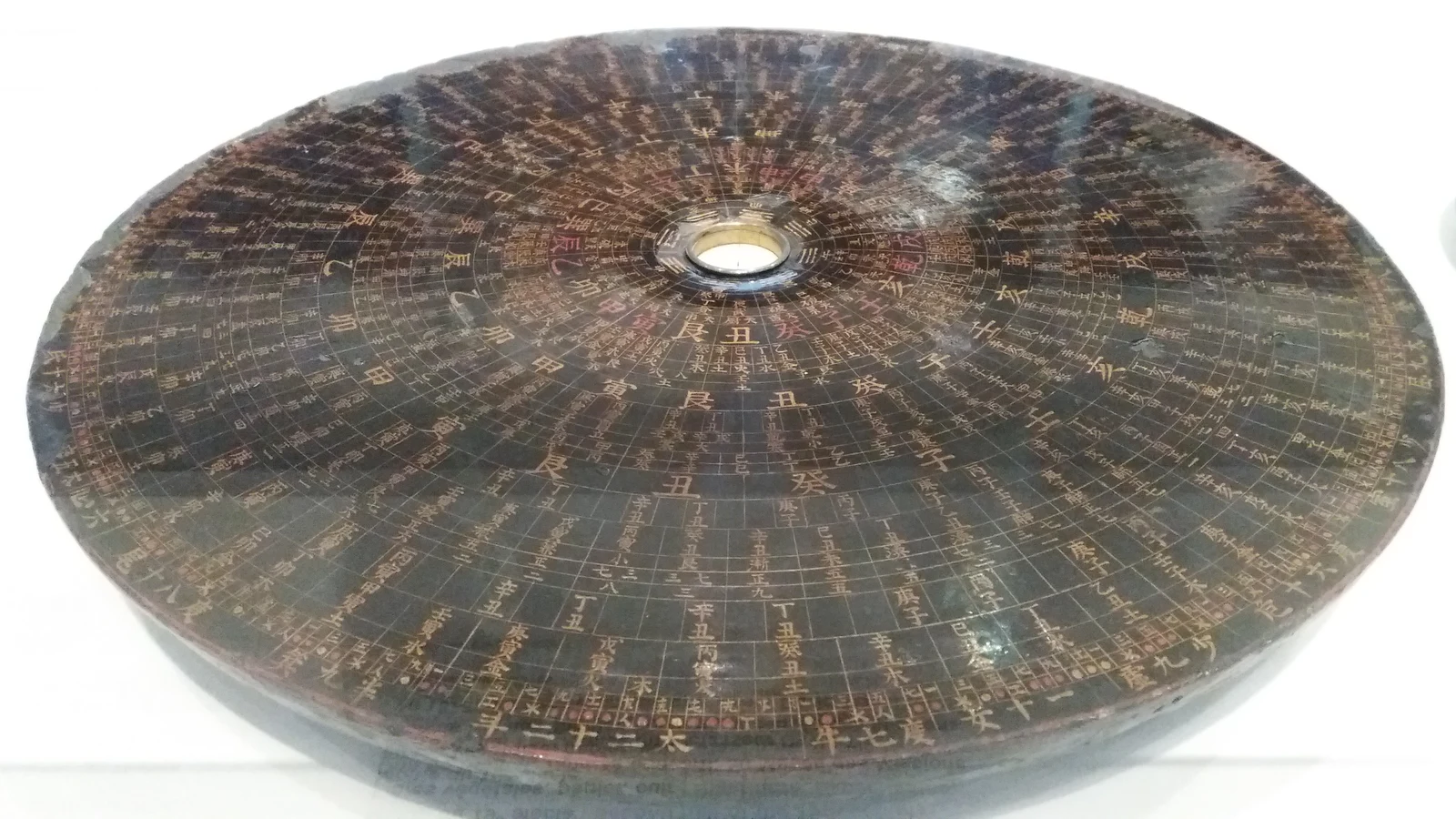
A phone is convenient for a broad orientation check. A baseplate compass supplies a magnetic needle, rotating scale and travel arrow. A luopan, also called Luo Pan, adds rings used in particular classical feng shui systems.
You do not need every luopan ring to identify an entrance as roughly east-facing. Conversely, a phone app displaying a bagua has not necessarily performed a classical assessment.

Check the north reference
Magnetic north and true north are different. NOAA defines magnetic declination as the angle between them, which varies with location and time.
Some apps can display true north using location-based information. Check the setting and documentation. Many classical feng shui instructions use magnetic bearings, but confirm the convention of the method before converting. Write “magnetic” or “true” in your log.
Apple cautions that environmental and magnetic interference can affect a phone compass. Troubleshoot movement in the reading before interpreting it as a property of the home.
Recognize the parts before taking a reading
On a baseplate compass, the direction-of-travel arrow belongs to the clear base, while the magnetic needle turns inside the capsule. The rotating degree scale and orienting markings serve a different job. Do not read whichever arrow happens to look most prominent.
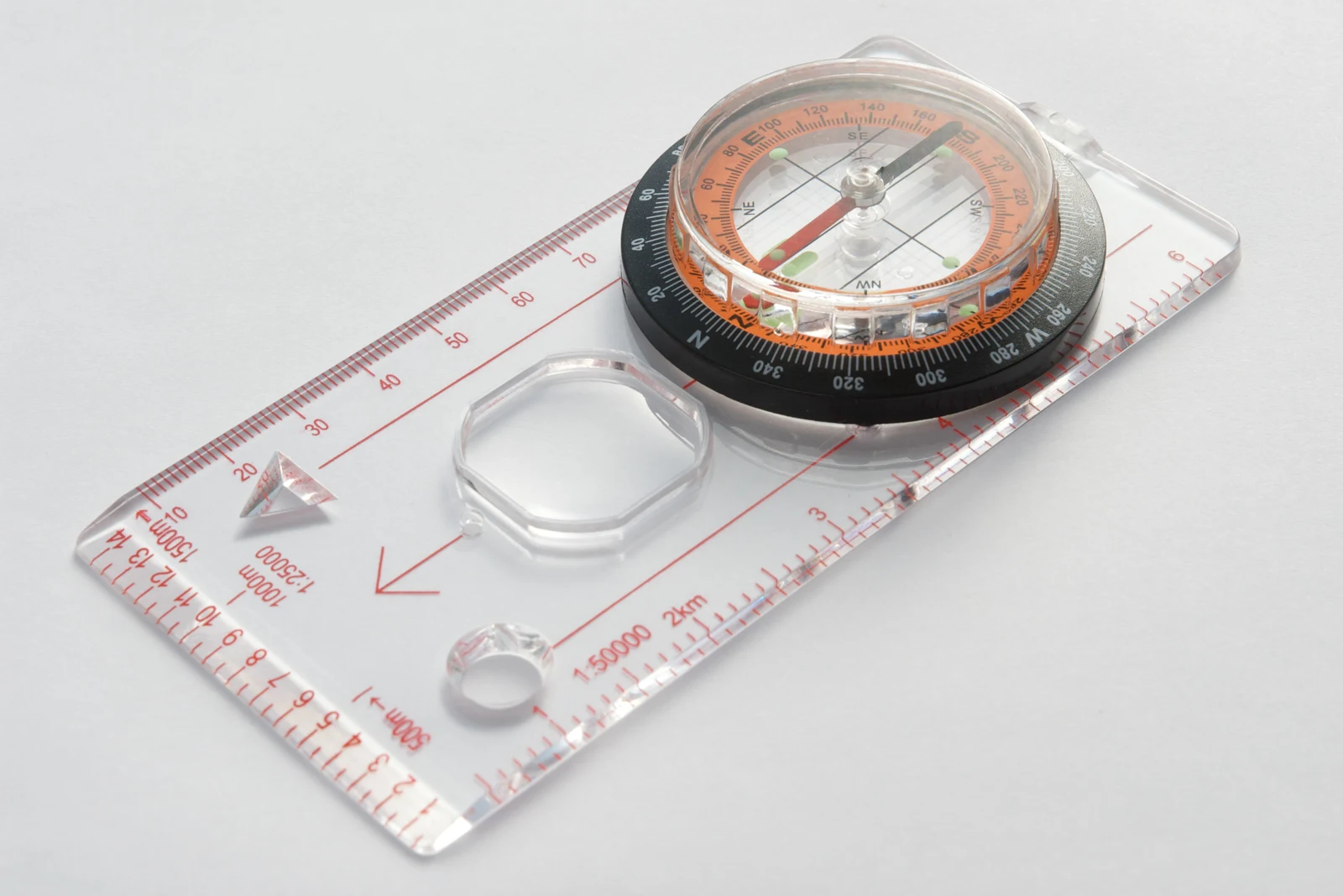
This close-up identifies the parts, not a completed entrance measurement. For your own reading, keep the compass level, point the travel arrow along the chosen outward line and align the north needle with the orienting markings as the manufacturer's instructions require.
Take a repeatable entrance reading in six steps
- Choose a safe outdoor position. Stand clear of traffic, steps and the door swing. Never lean out of a balcony to reach a facade.
- Face outward. Keep your back square to the entrance plane, not along the wall.
- Move clear of interference. Avoid steel frames, vehicles, magnetic phone accessories and large metal or electrical objects.
- Read the correct index. With a baseplate compass, point the travel arrow outward and align the orienting arrow with the north needle before reading the index. Follow your instrument's instructions if its design differs. Hold a phone as its app requires.
- Record at least three readings. Repeat from the same line and orientation. Keep the individual numbers.
- Cross-check nearby. Repeat a little farther from the facade if practical. Investigate substantial differences before using the result.
There is no fixed distance that removes every magnetic disturbance. Moving several feet away can help, but reinforced structures or nearby objects may require another position.
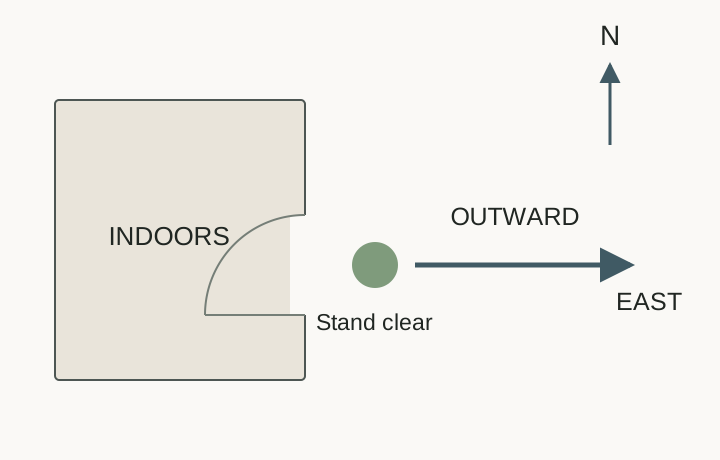
Record the conditions, not only the average
Hypothetical readings from one entrance measurement line
Scroll sideways to compare all columns.
| Reading | Bearing | Conditions |
|---|---|---|
| First | 88° | Outside door, facing outward |
| Second | 90° | Same position and device |
| Third | 89° | Same north setting |
These readings cluster around 89°, broadly east. A set such as 82°, 96° and 87° needs another check rather than a confident average. Repeatability does not prove that the device has no systematic error.
Keep the location, device, north setting, target and individual readings in your log. That makes a later recheck meaningful.
Convert a bearing into one of eight directions
The broad eight-direction system divides the circle into 45° sectors. North wraps across 0°, so 359° and 1° are neighbors.
Broad sectors, with lower bounds included and upper bounds excluded
Scroll sideways to compare all columns.
| Direction | Center | Degree range |
|---|---|---|
| North | 0° / 360° | 337.5° to 360°, then 0° to below 22.5° |
| Northeast | 45° | 22.5° to below 67.5° |
| East | 90° | 67.5° to below 112.5° |
| Southeast | 135° | 112.5° to below 157.5° |
| South | 180° | 157.5° to below 202.5° |
| Southwest | 225° | 202.5° to below 247.5° |
| West | 270° | 247.5° to below 292.5° |
| Northwest | 315° | 292.5° to below 337.5° |
This lookup is not a 24 Mountains chart, which subdivides the circle more finely for particular classical applications. Keep raw degrees even when adding a broad direction label. Near a boundary, rounding conceals uncertainty.
Do not average north as ordinary numbers
Readings of 358°, 0° and 2° cluster around north. Their ordinary arithmetic mean is 120°, a misleading result caused by the scale wrapping at 360°. Treat them as adjacent around 0°, or use a circular mean if you need a numerical summary.
Find the opposite sitting direction
For a defined facing bearing, sitting is 180° away. Add 180° if the result stays below 360°; otherwise subtract 180°.
A facing of 89° gives sitting at 269°, broadly west. This calculation describes an axis. It does not decide which facade should be called facing.
Apartments, side entrances and room sectors
Apartment example: the unit door points west into a corridor, while windows and the balcony face south. Record both descriptions separately. Ask which the selected assessment uses. There is no universal rule that every apartment must be read from the door or balcony.
Side-entry house: a door beside the garage may face east, while the main street facade faces south. It can be an east-pointing entrance without making the whole house east-facing for every method.
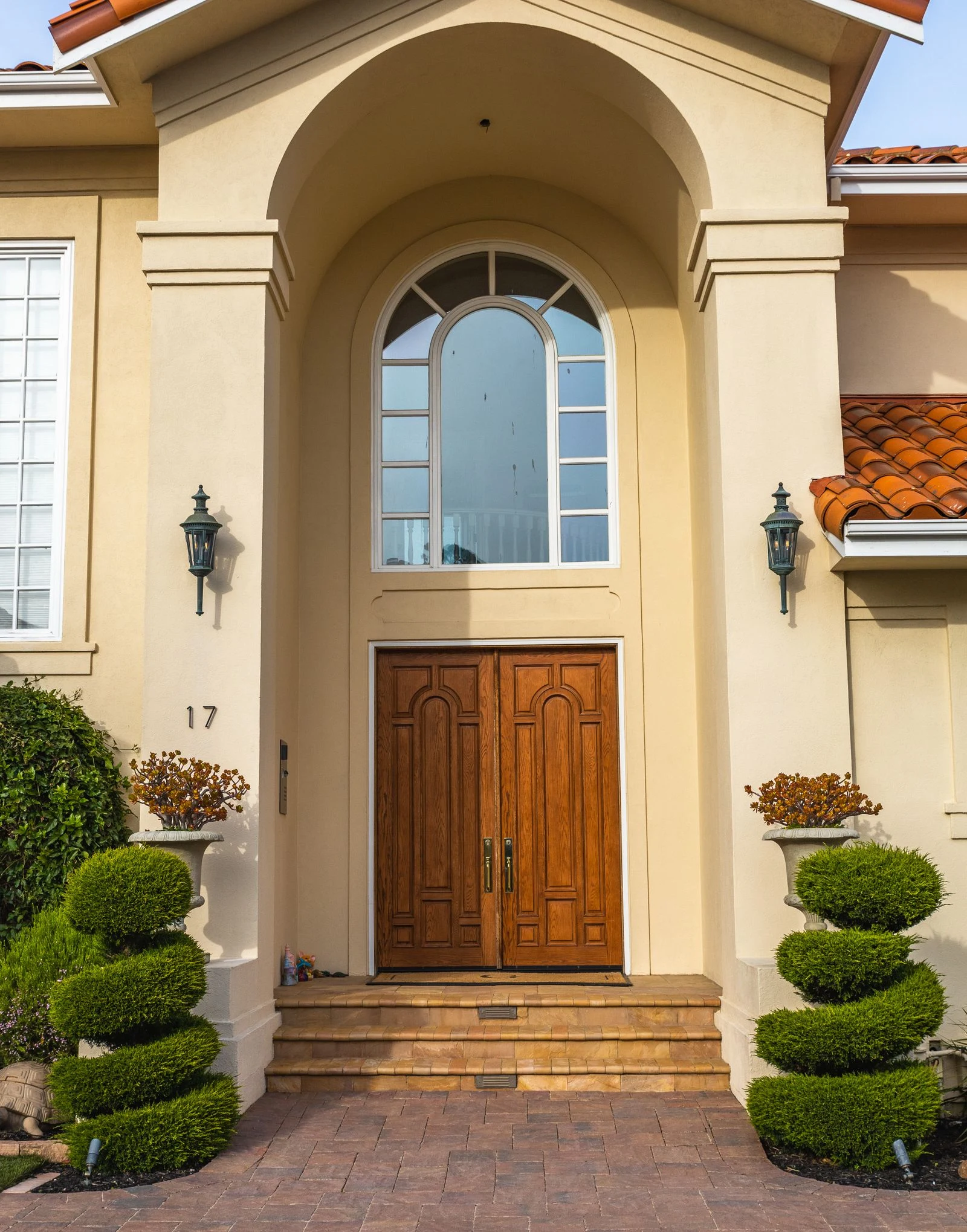

At an entrance like this, choose a safe, level position beyond the steps rather than balancing on a stair. Face along a line perpendicular to the closed doorway, not whichever way the path bends. Then recheck farther from the door hardware if readings fluctuate.
Room-sector question: finding southeast inside a room needs an outline, a defined center and north reference. It is not the same as reading the door. Use our floor-plan and bagua guides for the mapping context.
Troubleshoot before interpreting
Common compass problems and the next check
Scroll sideways to compare all columns.
| Problem | What to try |
|---|---|
| Numbers jump near the door | Move clear of the metal frame and repeat. |
| Two devices disagree | Compare north settings and follow calibration instructions. |
| Inside and outside differ | Record both positions; check nearby metal, equipment and magnets. |
| A sector boundary is crossed | Keep individual degrees and uncertainty, not the preferred label. |
| Door and balcony differ | Clarify the target and method rather than averaging them. |
If readings stay unstable or an advanced chart depends on a small angular difference, seek a competent practitioner. A basic bearing is not a complete Flying Star chart: building information, time periods and school-specific calculations can matter.
After measuring, our east-facing, south-facing and west-facing guides connect orientation with practical light and entrance choices.